

Record of the Langya Mountain
Date: 2023-03-20 View: 2868
Author: Si Xiong
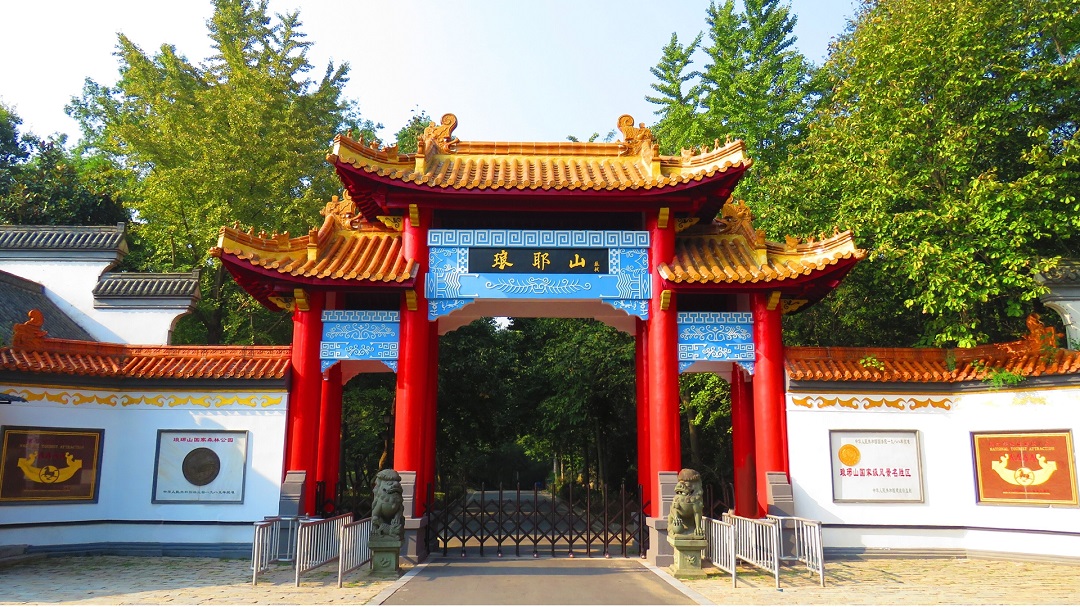
Surrounding the mountains of Chu. The mountain is also Langya Mountain.
Langya Mountain is located in the southwest of Chuzhou City, belonging to the east extension of the Huaiyang Mountains. Before the Eastern Jin Dynasty, it was originally unknown, and the locals collectively referred to it as the Motuo Ridge. In the late Western Jin Dynasty, Sima Rui, the king of Langya, stayed here for avoiding chaos. Later, Sima Rui became the Yuan Emperor of the Eastern Jin Dynasty, and this place was imbued with aura through the light of the emperor.
In the sixth year of the Dali period of the Tang Dynasty (771 AD), Li Youqing, the governor of Chuzhou, built the Baoying Temple (today's Langya Temple) here and renamed this mountain Langya Mountain.
Langya Mountain has 72 peaks, including Xiaofeng Mountain and Xiaofeng Mountain, with a total area of 115 square kilometers. The mountain is not high, and the highest Huashan is only 331 meters above sea level. The territory is densely covered with lush forests and secluded caves, with a network of blue lakes and flowing springs. There are rich varieties of animals and plants, and the landscape of the four seasons is quite different. Unfortunately, it has not attracted people's special attention and attention for a long time.
"The mountains and waters of Chu have gained more light from the writings of the Duke of Europe." The so-called "writings of the Duke of Europe" refers to Ouyang Xiu's "Records of Zuiweng Pavilion" in the Northern Song Dynasty.
In the fifth year of the Qingli reign of the Northern Song Dynasty (1045 AD), Duke Ou was transferred from the capital of Hebei as an inspector and demoted to Chuzhou as governor. In the summer of the following year, a glimpse of spring water was found in the deep valley at the foot of Fengshan Mountain in Langya Mountain. "Looking up from the left to the right, we enjoyed it, so we dug stones from the sparse spring, and created a ground for the pavilion." The pavilion was named "Fengle Pavilion", and we wrote the article "Fengle Pavilion Record.". In the same year, a mountain apart from the Fengle Pavilion, the abbot of the Kaihua Zen Temple in Langya Mountain, Zhixian, built the Zuiweng Pavilion for Ouyang Xiu. Duke Ou and his colleagues often come here to have fun and drink, as well as do official work. They write "The Story of the Drunken Weng Pavilion" to record it.
The advent of "Two Notes" created a sensation. In particular, "The Story of Zuiweng Pavilion", with vivid writing and exquisite language, not only praises Langya Mountain for its "beautiful forest valleys, magnificent and deep beauty", but also becomes a masterpiece through the ages due to the sentence "The meaning of Zuiweng is not in wine, but also in the mountains and rivers." It has been handed down to this day.
In the sixth year of Yuanyou in the Northern Song Dynasty (1091 AD), Su Shi was invited by the then governor of Chuzhou to write the "Records of Zuiweng Pavilion" and inscribed a tablet. The perfect combination of the "Owen Su character" has made Zuiweng Pavilion more famous in the world and made Langya Mountain more famous and famous.
Langya Mountain is combined with Fengle Pavilion and Zuiweng Pavilion, making it a scenic spot in Chuzhou. Zuiweng Pavilion ranks first among the "four famous pavilions" in China, and together with Fengle Pavilion, it has become a scenic spot that has always been desired by those who have explored and visited ancient times, and is also known as "Sister Pavilion"; The "Ziwei Spring" under the Fengle Pavilion and the Rang Spring at the Zuiweng Pavilion are collectively referred to as the "Sister Spring". Despite the vicissitudes of history, it has been repeatedly abandoned and thrived.
"The Story of the Drunken Weng Pavilion" fully demonstrates Ou Gong's pleasant feelings of leisurely sightseeing, drinking, and having fun. Some people may think that due to his demotion to Chu, he has the suspicion of not caring about political affairs. Actually, it is not.
Duke Ou, known as "Drunken Weng", apparently indulged in poetry, wine, and the joy of mountains and rivers, while still thinking about the country of the people. As the saying goes, "If you live high in a temple, you will worry about your people, and if you live far away in the Jianghu, you will worry about your ruler.".
Laozi Yun: I have nothing to do, but the people have changed themselves; I am quiet and the people are upright; I have nothing to do, but the people are rich; I have no desire, but the people are simple. Duke Ou deeply understood the essence of the sage's words, and when he knew Chu, he followed the "policy of leniency and simplicity.". Mr. Ou said, "To be lenient in vertical terms and to be simple in simple terms, political affairs will be lax and wasteful, while the people will suffer from their disadvantages. As I call it, to be lenient is not to be hasty; to be simple is not to be cumbersome and trivial." That is to say, governance emphasizes tolerance and simplification, and to act in accordance with human principles, not harsh and arbitrary, not cumbersome and trivial, not to seek fame, as long as things are done well. Zhu Xi commented on him, "During the third or fifth day of the reign, the number of events has been reduced from ten to five to six. After a month or two, the government is as calm as a monk's house."
Ou Gong knew Chu for two years and four months, not long. He left many cultural relics in Langya Mountain, as well as immortal poems and essays that have been handed down for thousands of years; "With a prominent political voice and the people living and working in peace and contentment, it has left an indelible memory for the people of Chu." We do not see any traces of governance, seek no reputation, be lenient and simple, and do not disturb them. Therefore, it is convenient for the people to do so. ".
Later, Duke Ou had the authority to know the Kaifeng government. His predecessor was Bao Zheng, the "Iron Face Old Bao" who was famous for his majesty. However, Duke Ou still followed the "lenient and simple policy" and managed the Kaifeng government in an orderly manner. In the Qing Dynasty, someone erected a memorial archway on the east and west sides of the Kaifeng Yamen, writing "Bao Yan" and "Ou Kuan" at the same time.
"The policy of leniency and simplicity" is the style of Mr. Ou's lifelong political work, which has won the hearts of the people. Like his immortal poems, they have been passed down from generation to generation and are still extolled today.
Local people say that Chuzhou's borrowing from the writings of the Duke of Europe does not stop at promoting its reputation, but always strives for simplicity in construction, management, and development. It is people-oriented and "convenient for the people wherever they come". It is more and more glorious by borrowing the light of the Duke of Europe.
In today's Chuzhou, the enchanted landscape of the Duke of Europe is still there. Langya Mountain is listed as one of the first ten national forest parks in China and a national key scenic spot. Natural or cultural heritage such as Langya Temple, Fengle Pavilion, Zuiweng Pavilion, Huifeng Pavilion, and Qingliu Pass are always shining with the light of humanity. In the Zuiweng Pavilion Scenic Area, although the pavilion has been damaged and repaired several times, the momentum of its wings remains unchanged; Let the spring still murmur, first into the square pool, then into the glass marsh, constant temperature throughout the year; "Ougong hand-planted plum blossoms, known as" Oumei ", have not forgotten to bloom for thousands of years;"; In addition, there is a relocated Lingxi Stone, which is accompanied by the "Lingxi Stone Story" written by Duke Ou, which tells the story of Lingxi Stone's repeated success and failure in favor and disgrace
Later generations built a "Two Sages Hall" on the north side of the pavilion, dedicated to Ouyang Xiu and Wang Yucheng, two wise and virtuous prefectures of the Northern Song Dynasty - which can be regarded as the best affirmation and praise for Ougong. In recent years, there have been new scenic spots, named after the text of the Duke of Europe. For example, "Tongyuan" has a square, music hall, and calligraphy gallery, named after "Drunken people can enjoy their music together, and awakened people can express themselves in text."; Walking along the Langya Ancient Road, there is a lake between the peaks, clear as a mirror, slightly renovated, and advocating nature. It is called the Deep Xiu Lake, which means "magnificent and deep Xiu". The scenic area is free for citizens all day, and is open 24 hours a day. Every day, there are a large number of tourists: young people are exercising their feet, children are playing, elderly people are dancing square dances, singing Huangmei Opera... Wandering in the Langya Mountain Scenic Area, there is a sense of relaxation and tranquility - how similar it is to the pleasant scene of Langya Mountain described by Mr. Ou in the past!
Mountains and rivers are smelled by people, or not infrequently seen. However, the style and moral character of Duke Ou as a writer, a politician, and a person have infiltrated the land of Langya Mountain. They have been praised for thousands of years, and have been praised by later generations. They are thought-provoking. Through the ages, how many people can compete with it?
Langya Mountain is surrounded by Chu from ancient times to the present. However, all around Chuzhou are beautiful, and all around Chuzhou are good. Believe me!
- Prev: None
- Next: Record of the Zuiweng Pavilion

