

Langya Mountain Temple Fair
Date: 2021-10-18 View: 2125
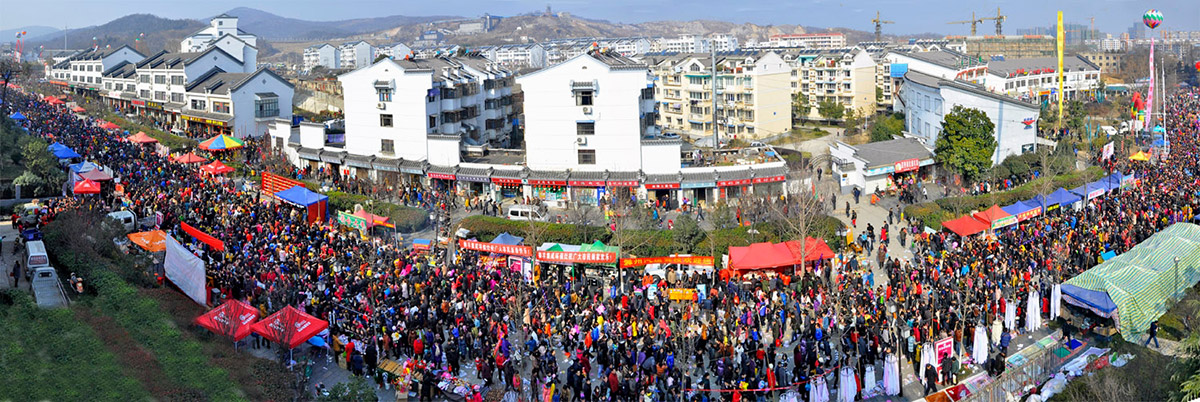
Langyashan Temple Fair is a traditional folk custom event with a long history, the largest scale and the widest influence in East Anhui Province. It is held on the ninth day of the first lunar month of each year. Relevant historical records record that:"…… For many years, on this day, many pilgrims come to the temple to burn incense and worship Buddha. Whether it is cloudy, sunny, rainy or snowy, people go to the temple regardless of the distance to pray for peace and fragrance. With the progress of the times and the development of society, the traditional temple fairs gradually derive and enrich the content with the distinct flavor of the times, and become a platform for people to visit mountains and enjoy scenery, trade with businessmen, exchange of information and dance together. The rise and fall of temple fair activities is closely related to the development of local society, and it is a unique and charming folk cultural phenomenon with multi-cultural infiltration.
The origin and origin of the temple fair are all related to Taoism.
One saying is that the ninth day of the first lunar month is the birthday of the Jade Emperor. On this day, Taoists from far and near gathered in the mountains to hold grand Taoist altar activities, which attracted many worshippers and good women to burn incense to worship, praying for the next year's smooth weather, fruitful storehouses, happy life and prolonged children. In the Eastern Jin Dynasty, Taoist priests lived in seclusion. Jade Emperor's Palace, Xuan Emperor's Palace, Three Emperors'Palace, Yuan Jun's Palace, Ertianmen and Santianmen were built successively. During the Ming Dynasty, there was also a Taoist management organization "Tao Zhengsi". Taoist activities were very active. Famous Taoist broadcasters spread around a hundred miles and spread ten or ten centuries, gradually becoming the embryonic form of "catching up with temple fairs on the ninth day of the first lunar month".
Another legend is that Chu people thanked and commemorated a Taoist goddess, Bixia Yuanjun. Legend has it that long ago, Langya Mountain was only a remote and unknown wild mountain with weeds. Bixia Xiangu, daughter of Dongyue Great Emperor, who was playing in the world because of the cold and lonely Tiangong, occasionally drifted to the mountains. In despair, she had the idea of changing mountains and landscapes. So she went back and forth to heaven and earth, without any effort, and took Tiantian Ganlu to sprinkle mountains and fields, making Langyashan grow flowers and trees, and the scenery gradually beautiful. The news that Bixia Xiangu had created a fairyland on Earth spread to the Heavenly Palace. Her sisters asked all the people to enjoy it. The date chosen was Xiangu's birthday, which was the ninth day of the first lunar month. Later, Chu people built the Bixia Palace on the mountain. Every year on this day, they went to burn incense to offer sacrifices. Over time, it became a custom.
The Temple Fair of Lao Lao Lang Ya Mountain was truly a "grand, lively and extraordinary" folk activity, which was generally accepted by the people during the Hongwu period of the Ming Dynasty. After the founding emperor Zhu Yuanzhang built the capital of Nanjing, he sent his prince and ministers back to Fengyang to worship the imperial mausoleum every year. Chuzhou was an important post station through which he stayed and rested every time. At that time, the court set up Nantaipu Temple, a horse administration authority directly under the central government, in Chu. A group of court officials who traveled here naturally accompanied climbing sacrifices every time to pray for the people of the world. The scene can be described as "the noise of cars and horses, shoulder-to-shoulder hubs". In order to highlight the atmosphere of prosperity, Cathay Pacific and people's security, the government intends to support and approve the "Temple Fair" activity, so that people can gather and enjoy, from spontaneous folk activities to official organizations, which has been followed year after year, with a high incense and a long-standing reputation, "a grand situation in eastern Anhui Province".
The traditional folk custom of the Temple Fair of Lao Lao Mountain has gone through different social stages, such as wars and turmoil, man-made disasters and natural disasters, and prosperity of Shengping. It has been in the ascendant and decline, and has been inherited from generation to generation because of its trust and bearing the good and good wishes of the local people.
During the years after the founding of New China, temple fairs gradually regained popularity. During the Cultural Revolution, religious activities disappeared and temple fairs were interrupted.
In 1980, with the approval of the Anhui Provincial People's Government, the "Langyashan Administration Office of Chuxian District" was formally established to plan scenic spots and restore ancient buildings. The rain, dew and spring breeze at the Third Plenary Session of the Eleventh Central Committee of the Communist Party of China made the rural reform fruitful and the peasants had a bumper harvest, thus reviving the traditional temple fair. In 1981, more than 80,000 people participated in the temple fair.
In 1982, Bengbu Branch Bureau of Shanghai Railway Bureau opened a special line for the Temple Fair of Langyashan Mountain, which is convenient for people along the way. The number of people attending the temple fair reached 100,000, which is the most in history. With the continuous implementation of the Party's policy of enriching the people, the vigorous rise of tourism industry, the continuous enrichment of urban and rural civilizations and cultural life, temple fair activities in the following years entered an unprecedented golden period. "People surge like tide, and the grand event is unprecedented." In addition to the local people, Shanghai, Nanjing, Yangzhou, Bengbu, Hefei and other places have a large number of visitors, who come to Shanghai, Nanjing, burning incense, sightseeing, and other places. Play. "The former calls for, the latter should be carried, exchanges and never ceaseless", the prosperous scene appears repeatedly. Later, with the development of transportation, road passenger flow increased sharply, and temple fairs were suspended in 1998.
With the growing popularity and reputation of temple fairs, businessmen began to participate, "popularity drives business opportunities." The original pure temple fair activities of burning incense to worship Buddha and entertaining oneself have added to the commercial atmosphere. During the temple fair activities after the 1980s, commercial activities and services began to intervene and rise. From the eighth to tenth day of the first lunar month, state-owned, collective and individual merchants would set up tents and stalls along both sides of the ancient road and around the scenic spots to engage in business activities such as catering, local products and tourist souvenirs. Since 1990, apart from carrying on religious and commercial activities, the temple fair theme has changed from time to time and according to the situation. For the peasant friends, it has added such contents as "sending science and technology", "sending culture" and "sending law". It has exhibited exhibition boards, sent materials, and so on.

