

Scholars of all dynasties chant Oumei
Date: 2022-03-07 View: 2138
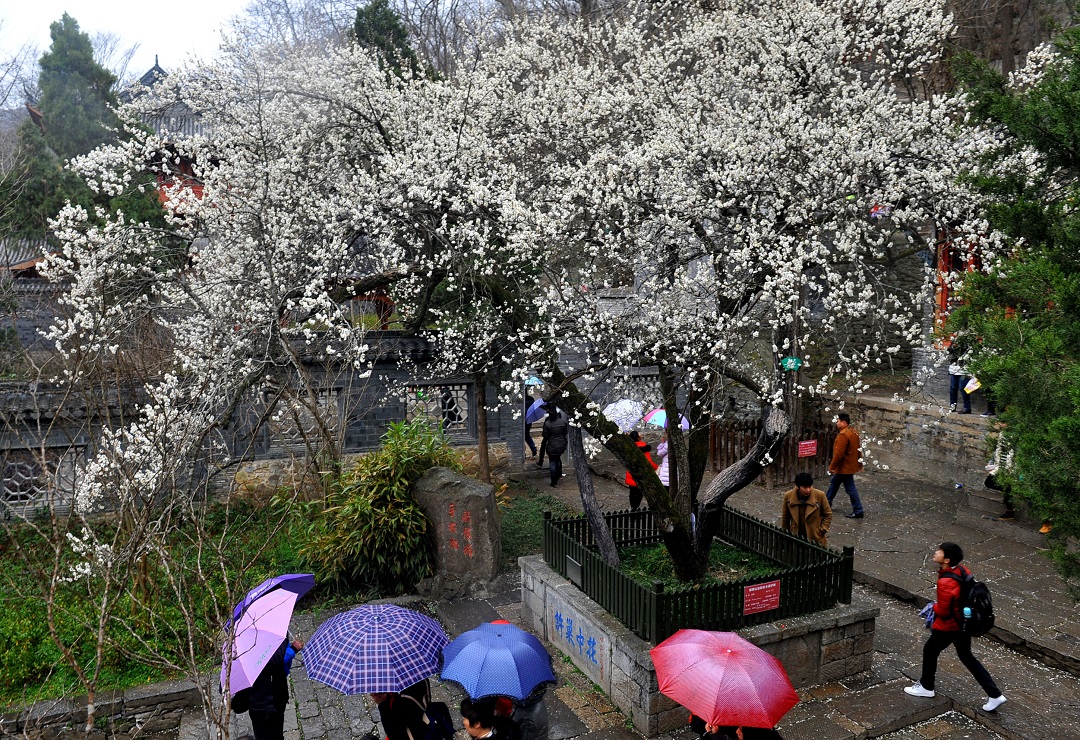
As a symbol of Chinese national integrity, plum blossom has gone far beyond its plant itself, ranking first among the four gentlemen in the flower of "plum, bamboo, orchid and chrysanthemum", and constantly elucidating new images in the writings of literati of past dynasties. People are familiar with Lu You's "scattered into mud to grind the soil, only fragrant as before", "Wang Anshi's" distant knowledge is not snow, for the sake of dark fragrance","Mao Zedong's"when the mountains are full of flowers, she laughs in the bushes", "Lumeipo's" Meixun snow is three-white, but the snow loses a fragrance of plum", Wang Mian's"don't praise the color, just leave a clean air full of heaven", and Li Qingzhao's"deep courtyard". Deeply, for whom the cloud window fog Pavilion is late in spring, languishing and damaging the fragrant posture ", of course, there is Lin Zhi's"clear and shallow water, dark fragrance floating in the evening of the moon", which is also the couplet of Ou Mei's opposite shadow incense pavilion. These poems or chants of plum are noble, arrogant and upright, or extraordinary and refined, implicit and gentle, greatly enriching and expanding the image and connotation of plum blossom. There is also a plum blossom on Mount Langya, and poets of all dynasties have chanted many poems. This plum flower was planted by Ouyang Xiu in the Northern Song Dynasty, so it is called "Oumei" by the world. Because it is similar to apricot blossom period, its fruit is also like apricot, so it is also called "Apricot Plum".
Historically, the climax of singing Ou Mei was in the Ming and Qing Dynasties, which coincided with the revival time of Chuzhou, where Yao Weng Ting was located. At the end of Yuan Dynasty and the beginning of Ming Dynasty, Chuzhou was a place for military strategists to contend for, so it suffered many times. When the Ming Dynasty was founded, Chuzhou became prosperous as the place where Zhu Yuanzhang, the ancestor of the Ming Dynasty, grew up. Chuzhou in the Qing Dynasty was a "thoroughfare of nine provinces" with frequent economic and cultural exchanges. As a result, a large number of works of visiting Longyan Mountain and Youweng Pavilion appeared in the Ming and Qing Dynasties. Oumei, as an important scenic spot of the ancient building complex of Youweng Pavilion, also appeared in the writers'writings.
There are many poems about Ou Mei in Ming and Qing dynasties. Here, we choose several poems for readers.
(1) Timei Pavilion
(Ming) Ye Maochai
Qiao Zhi is very strong and can snow, and the jade stamens are uneven and dawn stars.
Tiaoding Ding should be sour and bitter, and rewarding should protect the leaves and seedlings.
Mr. Ao's hand is far away from the breeze, so he must be drunk and awake.
The author of this poem is Ye Maocai, Shaoqing of Taipu Temple in Nanjing. Because Taipu Temple was set up in Chuzhou in Ming Dynasty, a large part of the poems about Langyashan and Zuiweng Pavilion were written by Taipu Temple officials. Ye Maochai was not only an official, but also a "Eight Gentlemen of Donglin" with Gu Xiancheng, Gu Yuncheng and Gao Panlong at that time. We can understand the author's reverence for Ouyang Xiu from the two sentences in this poem: "Mr. planting a clear breeze far away, sitting drunk and awake".
(2) One of the two heads of the north-central line
(Ming) Wang Yangming
Plum blossoms and snow in the north of the Yangtze River are fragile, and a tree in the window looks at itself.
Chat a few gifts in front of him. It's cold to cherish the fragrance.
This poem was written by Wang Yangming (1472-1529), a philosopher, thinker and master of mind studies in the Ming Dynasty. There were two branches of psychology and psychology in the development of Confucianism in ancient China to the Song and Ming Dynasties. The first branch was Mencius, and the first was Cheng Hao in the Northern Song Dynasty. By the time of Lu Jiuyuan in the Southern Song Dynasty, Confucianism had been able to resist Zhuxi's Neo-Confucianism. However, influenced by the rulers, it was always difficult for Confucianism to flourish. By the mid-Ming Dynasty, Wang Yangming had put forward the concept of "mind learning" and pointed out that "conscience learning" was The purpose of Wang Yangming's theory of mind is to integrate knowledge with practice, so Wang Yangming's theory of mind is a practical one. This poem was written by Wang Yangming in the eighth year of Zhengde (1513) in Churennan Taipu Shaoqing. Although it is a common farewell poem, there is not a breath of fresh air in it. The closing sentence "A few gifts and chats in front of the line, cherishing the fragrance is the age of cold" is comparable to Wang Changling's sentence "If relatives and friends in Luoyang ask each other, a piece of ice heart is in the jade pot". It uses things to describe people, and uses physical characteristics to compare human feelings, few words, and deep feelings emerge.
(3) One of the Three Drunken Weng Pavilions after Rain
Wang Shizhen (Qing Dynasty)
Omei Yingchi Pavilion, half an acre scattered Qingyin.
Old cadres still exist in ancient times, and solitary flowers have blossomed up to now.
Bingxi is far from the temple, and the snow road goes deep into the mountains.
At this time, the eaves are well searched, and the cold fragrance accompanies the bitter chant.
This poem was written by Wang Shizhen (1634 - 1711), a literary giant in the Qing Dynasty. It is a generation of master craftsmen and is also known as "King of the North and South of Zhu" with Zhu Yizun. Although the poem was written by Wang Shizhen in the middle of the rain, it has a clear image and a high style. It has a close view around Oumei Mountain and a whole snow scene around Langyashan Mountain. It has the appearance of appreciating plum and smelling the fragrance of plum. The last sentence jumps out of the scenery and sublimates philosophical thinking with "cold fragrance" accompanied by "bitter chant". Wang Shizhen advocated the theory of "verve" in his poetry theory, which can be seen from this poem.
(4) Chanting Ou Mei (two)
Zhang Pengyi (Qing Dynasty)
Gumei Kai, by the side of Drunken Weng Pavilion, is the envoy of Shiheng Wen.
From the past Luling Mausoleum to the present Silk Wind Music Title Cup.
Peak circuit turns to smoke and smoke, birds singing and flowers fragrant sunset urges.
Great elegance still lingers, Tianpei Lao is arrogant and arrogant.
Gufang first blossoms to the hundred flowers, whisks the sill the westerly wind to meet the ground.
Shadow the night moon of the brewing spring, Xiangfuqu water point Xia Cup.
Yin into a solid conditioning soup, iron bone Bingxin Shuqi urged.
Ouyang's hand is there for thousands of years, and the North Branch is like a cold wood.
This poem was written by Zhang Peng-yi, a famous minister and river expert of the Qing Dynasty (1649-1725). Zhang Pengti, an official and a scholar in Shangshu and Wenhua Dian University, was good at water control. He served as Governor of the Yellow River for ten years. Kangxi called him "Heaven".

