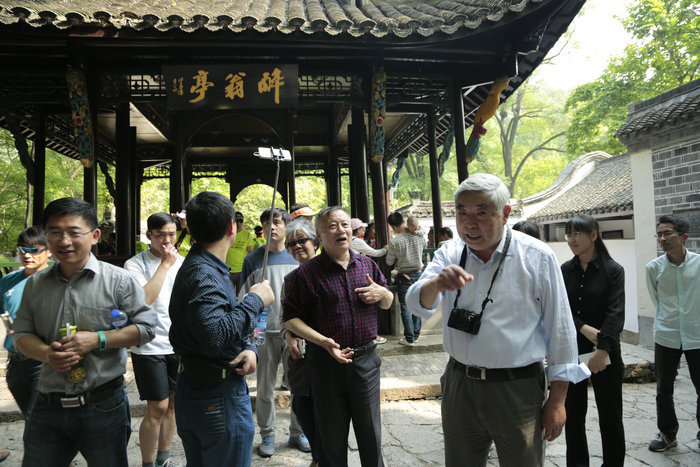
The Feeling of "ZuiWeng Pavilion"
Date: 2022-12-12 View: 2928

(Author: Chinese Society of Landscape Architecture consultant, Hangzhou Landscape and Cultural Relics Bureau, former director Shi Dong Dien)
I am very happy that I can come to Chenzhou, which I have been waiting for for a long time, to participate in this "Ting Culture and Garden Science Seminar", which is a good learning opportunity for me.
As early as the middle school age of more than 60 years ago, the textbook of the "Drunkard Pavilion" by Ouyang Xiu has been read in the middle school textbook. "The meaning of the drunkard is not in the wine, and the mountains and rivers are also between the mountains and rivers" has become a famous saying of women and children. The famous sentence in "Drunkard Pavilion" is also known as the mountain, the southwestern peaks, the Linyi Youmei, the hopeful but the deep show, the 琅琊 also, so the mountain has long been a long-cherished place.
As a landscape gardener, there is a unique feeling for the pavilion. In all buildings, the pavilion is simple in structure and small in volume, but it is an indispensable stunner in Chinese landscape architecture, with the most universal value and profound garden culture.
The pavilion is the most humanized scene in the landscape garden. "Yingtings Pavilion" can be seen everywhere and has complete functions. From the very beginning, it has become the most popular service. From the earliest "passing pavilion" for people to rest, to the universal application in the garden in the future, Tingna has a tour, a view and a view. It can be called "no pavilion". . Ouyang Xiu also personally built Fengle Pavilion in Zhangzhou. He casts stone in Fengshan sparse spring and creates a pavilion. While the monks traveled with each other and shared with the people, Ouyang Xiu realized the construction and utilization of the pavilion in the landscape garden. The humanistic thought shared with the people also shows that the beautiful life brought by the landscape garden reflects the value of life beauty and social beauty. We came to Ganzhou to learn and understand the rich cultural connotation that Ouyang Xiu gave to the pavilion. As a result, there are many famous pavilions in China, there is a famous story or many historical stories, which are worthy of our in-depth study.
There are many pavilions overseas, which can be said to be Chinese. For example, there are Chinese pavilions in the Greenwich Garden in England and the Balgart Gardens in France, or Chinese pavilions are a contribution to the world gardens. Therefore, the application of the pavilion is China. The embodiment of excellent cultural characteristics.